










SATERA - Space-based composite ADS-B and multilaTeration systEm validation thRough scalable simulAtions
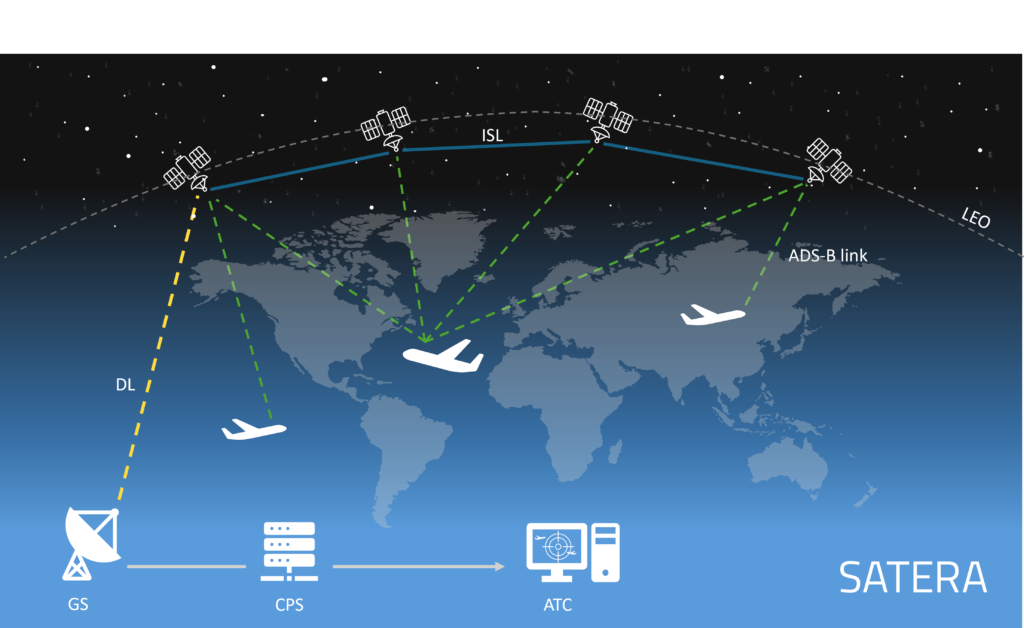
The European SATERA project addresses the critical challenge of ensuring the integrity of space-based surveillance systems, specifically Automatic Dependent Surveillance-Broadcast (ADS-B). As air traffic grows, ensuring the accuracy and reliability of these systems is essential. SATERA aims to validate an integrity estimator for space-based ADS-B by comparing reported ADS-B message positions with estimates obtained through space-based multilateration (MLAT) systems.
Objectives
The main objectives of SATERA are:
- Define an initial operational description that identifies all stakeholders, details the fleet’s CNS (Communication, Navigation, and Surveillance) equipment, and outlines available air traffic services.
- Adapt the system architecture described in ED-142A for a composite ADS-B and Wide Area Multilateration (WAM) surveillance system to fit space-based system requirements.
- Develop theoretical models to evaluate and compare the proposed architecture, establishing a comprehensive list of functional requirements and interface descriptions compiled into a Functional Description Document.
- Adapt performance requirements for a space-based system according to ED-142A for low, medium, and high en-route traffic densities.
- Develop a system performance prediction tool to calculate the theoretical performance of an MLAT system with receiving stations aboard a constellation of small low Earth orbit (LEO) satellites.
- Validate the SATERA solution at a TRL2 technology readiness level using an end-to-end system evaluation tool developed by the research team.
Concept
SATERA introduces an innovative approach to validating space-based ADS-B surveillance integrity by leveraging a composite system that integrates multilateration (MLAT) techniques. Unlike traditional ground-based systems, SATERA envisions a surveillance architecture where ADS-B signals are received by a constellation of small LEO satellites, enabling global air traffic monitoring.
The core idea is to compare ADS-B position reports with independent position estimates derived from space-based MLAT. This approach allows for real-time integrity monitoring and enhances confidence in space-based surveillance. By using scalable simulations and predictive models, SATERA ensures that the proposed system meets the necessary performance and reliability standards for future airspace management solutions.
Methodology
The project followed a structured approach:
Research and Development: Identifying operational needs and defining the technical requirements for a space-based composite surveillance system. This phase included adapting the ED-142A architecture for a combined ADS-B and MLAT solution, ensuring compatibility with satellite-based operations.
Simulation and Validation: Developing theoretical models and a system performance prediction tool to assess the accuracy and integrity of the proposed surveillance framework. Scalable simulations were conducted to evaluate MLAT performance in different air traffic scenarios and space-based receiver configurations.
Stakeholder Involvement: Collaborating with regulatory bodies, air navigation service providers, and industry stakeholders to align with existing aviation standards and ensure real-world applicability of the proposed solution.
Outcomes
Key outcomes of the project include:
- A validated integrity estimator for space-based ADS-B systems.
- Theoretical models and performance prediction tools for space-based MLAT systems.
- Recommendations for adapting composite surveillance system architectures for space applications.
Impacts
SATERA is expected to:
- Advance Europe’s leadership in space-based air traffic surveillance and integrity monitoring.
- Enhance the safety and reliability of air traffic management through validated integrity monitoring techniques.
- Strengthen collaborations between regulators, research institutions, and industry stakeholders, ensuring a lasting impact on space-based surveillance adoption.
Project information:
Grant ID: 101164313
DOI: 10.3030/101164313
Start date: 01 July 2024
End date: 31 December 2026
Project duration: 30 months
Budget: € 1.761.498,75
Funded under:
European Commission
Climate, Energy and Mobility
SESAR Programme: Digital European Sky
Consortium
The project is being executed by a consortium of leading organizations from Europe and other regions, including renowned research institutions, technology providers, and air traffic surveillance experts. Their combined expertise plays a key role in advancing the integrity and reliability of space-based surveillance systems, contributing to the future of global air traffic management.