












U-AGREE - U-space Air and Ground Risk modEls Enhancement
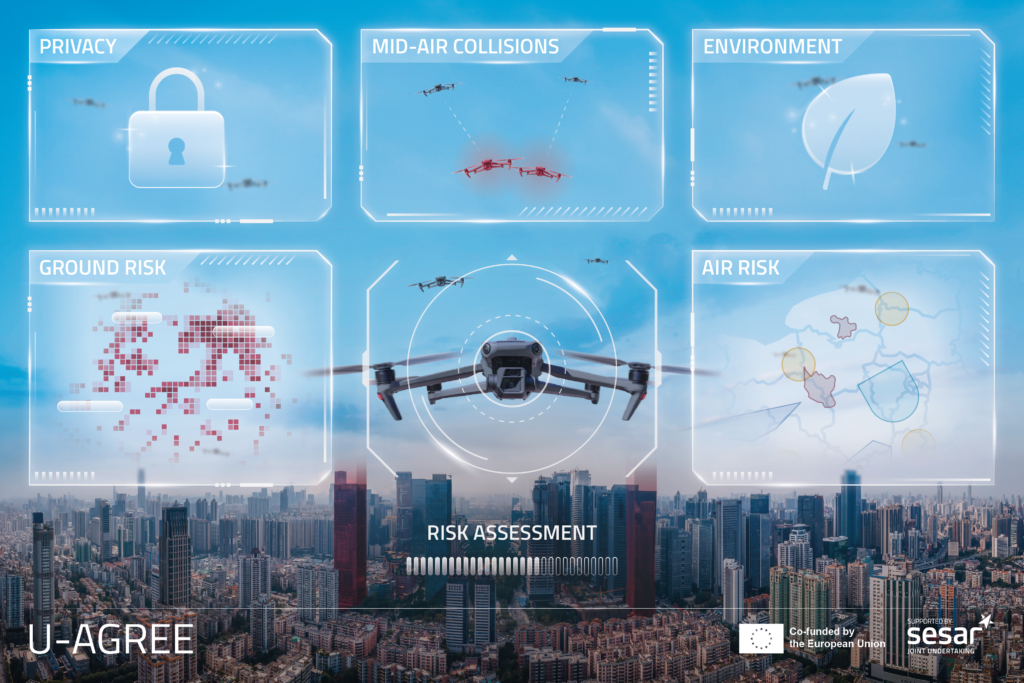
The U-AGREE project works on seamlessly integrating unmanned aircraft systems (UAS) into European airspace by designing a comprehensive risk assessment framework. This initiative seeks to enhance U-space regulations and refine the Specific Operations Risk Assessment (SORA) methodology, enabling a more precise and data-driven approach to risk evaluation. By streamlining approval procedures and fostering economically sustainable U-space operations, U-AGREE paves the way for the next generation of UAS integration.
Objectives
The main objectives of U-AGREE are:
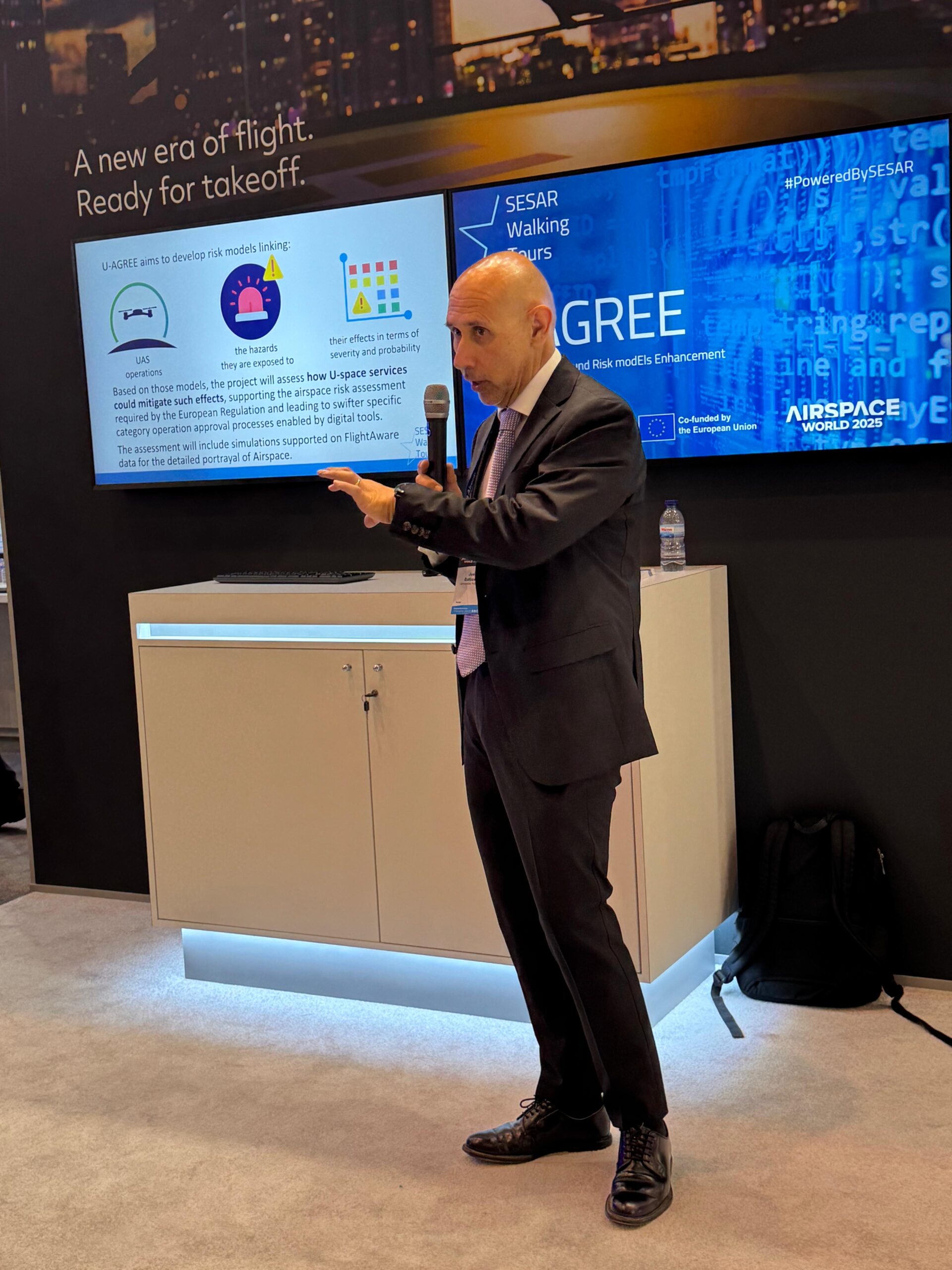
- Develop an integrated risk model linking UAS operations to potential negative effects on safety, security, privacy, and the environment.
- Support airspace risk assessments required by U-space European regulation.
- Propose improvements to the SORA methodology to allow for quantitative risk estimation, facilitating digital implementations and swifter operational approvals.
- Account for U-space services that mitigate risk, reducing the burden of meeting SORA operational safety objectives and enabling economically viable operations and business models.
Concept
U-AGREE introduces an innovative approach to risk assessment by developing a comprehensive model that quantifies the risks associated with UAS operations. The project focuses on identifying realistic UAS operation scenarios, assessing associated hazards, and establishing risk metrics. By developing mathematical models of mitigation barriers and integrating them into U-space simulators, U-AGREE aims to enhance the safety, security, privacy, and environmental compatibility of UAS operations.
Methodology
The project followed a structured approach:
- Scenario Identification and Hazard Assessment: Identify realistic scenarios where UAS operations will take place and assess them to identify all potential hazards to safety, security, privacy, and the environment.
- Risk Metrics and Thresholds Definition: Collaborate with relevant stakeholders, including civil aviation authorities and common information service providers, to agree on metrics and thresholds for measuring risks associated with identified hazards.
- Mathematical Modeling and Mitigation Strategies: Develop mathematical models linking hazards to their effects and define mitigation barriers using U-space services, along with algorithms to quantify their effectiveness in terms of risk reduction.
- Integration and Validation: Integrate the developed models into state-of-the-art U-space simulators to evaluate their applicability and relevance in the previously identified representative scenarios.
Outcomes
Expected outcomes of the project include:
- A validated integrated risk model for UAS operations.
- Amendments to the SORA methodology enabling quantitative risk estimation.
- Recommendations for incorporating U-space services as mitigation measures in risk assessments.
- Tools and guidelines to support faster operational approval processes and the development of economically viable U-space operations and business models.
Impacts
U-AGREE is expected to:
- Enhance the safety, security, privacy, and environmental compatibility of UAS operations in European airspace.
- Facilitate the integration of UAS into U-space by providing a robust risk assessment framework.
- Support regulatory bodies in implementing effective risk mitigation strategies.
- Promote economically viable U-space operations and business models through streamlined approval processes.
Project information:
Grant ID: 101167187
DOI: 10.3030/101167187
Start date: 01 September 2024
End date: 28 February 2027
Project duration: 30 months
Budget: € 1.018.053,75
Funded under:
European Commission
Climate, Energy and Mobility
SESAR Programme: Digital European Sky
Consortium
The project is executed by a consortium of leading European organizations, including renowned research institutions, technology providers, and air traffic management experts. Their combined expertise plays a key role in advancing the integration of UAS into European airspace, contributing to the future of safe and efficient U-space operations.